
Baxters wins Progressive Rehabilitation Award
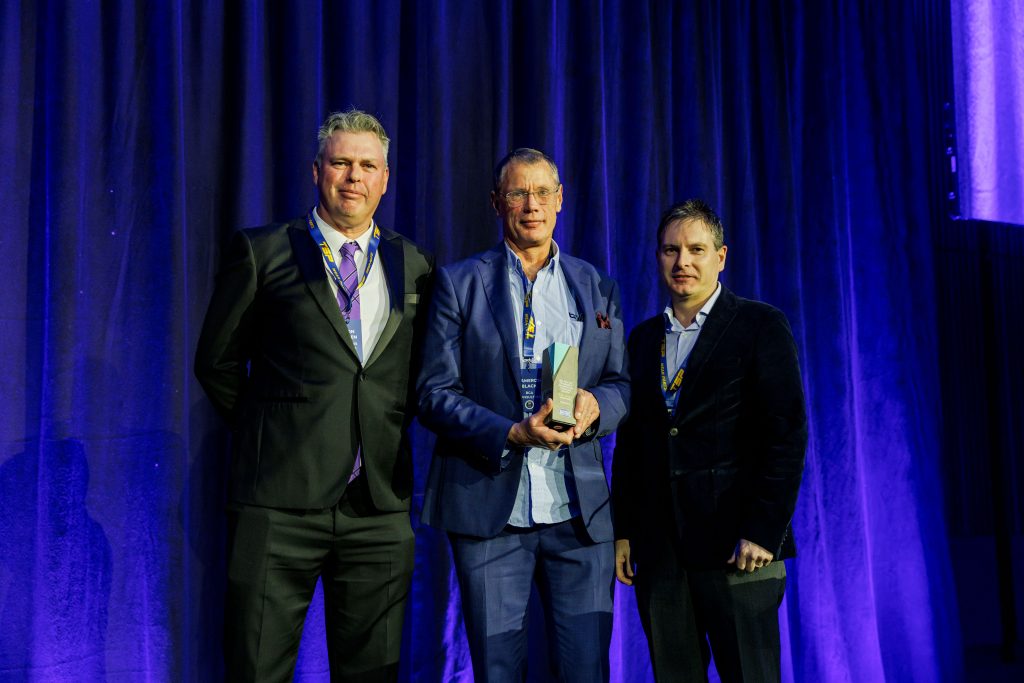
Baxters Concrete and Quarries was awarded the CMPA Progressive Rehabilitation Award (Small quarries category), sponsored by Resources Victoria, at the CMPA Annual Dinner on 30 August 2025. Cameron Black from BCA Consulting accepted the award on behalf of Baxters.
Submissions were assessed on how well the nominee demonstrated delivery of effective progressive rehabilitation. Judges considered elements of planning, delivery and outcomes, including:
- Standard of rehabilitation delivered;
- Alignment with approved rehabilitation plan;
- Approach to monitoring, assessing and improving rehabilitation activities; and
- How operational decision-making reflected rehabilitation objectives.
They were recognised for their approach to ensuring rehabilitation success in a flood prone environment.
Located on the bank of the Murray River, Baxters deliver high quality concrete to clients around northeast Victoria and the southern Riverina.
The concrete and quarry business has developed strong relationships across the industry since the concrete plant was established around 34 years ago.
With a long-standing commitment to effective, sustainable and resilient rehabilitation practices, they have undertaken historical and ongoing rehabilitation. Their focus was Work Authority 487 (WA487), located at Goynes Road, West Wodonga, Victoria.
“Our rehabilitation strategy has been carefully designed for long-term flood resilience, with landform stability at the core of our work,” said Brendan Baxter.
Guided by multiple flood studies, geotechnical assessments, and first-hand experience through decades of high-flow events, their site has been Rehabilitated to endure long into the future.
Planning
Planning was governed by an updated Rehabilitation Plan in 2023, with the following key elements included:
- End-Use Alignment: Rehabilitation aimed to return the land to safe, stable and sustainable general farming and animal husbandry use, incorporating water bodies formed from pit lakes.
- Flood-Informed Landform Design: Informed by historical flood behaviour, the site design incorporate wide upper batters, submerged slopes, and beaching zones. Profiles are geotechnically sound and hydrologically stable, ensuring long-term erosion control and safe water conveyance.
- Material Reuse: Topsoil and overburden were retained and reused on-site, which reduced haulage and maintained soil biology.
- Vegetation Selection: Revegetation focused on locally indigenous species, particularly those adapted to the Riverine Grassy Woodland EVC295, ensuring ecological compatibility and erosion resistance.
- Maximum Disturbed Area: Active disturbance was limited to 14 hectares at any given time, ensuring active control over rehabilitation progress.
Historical Rehabilitation
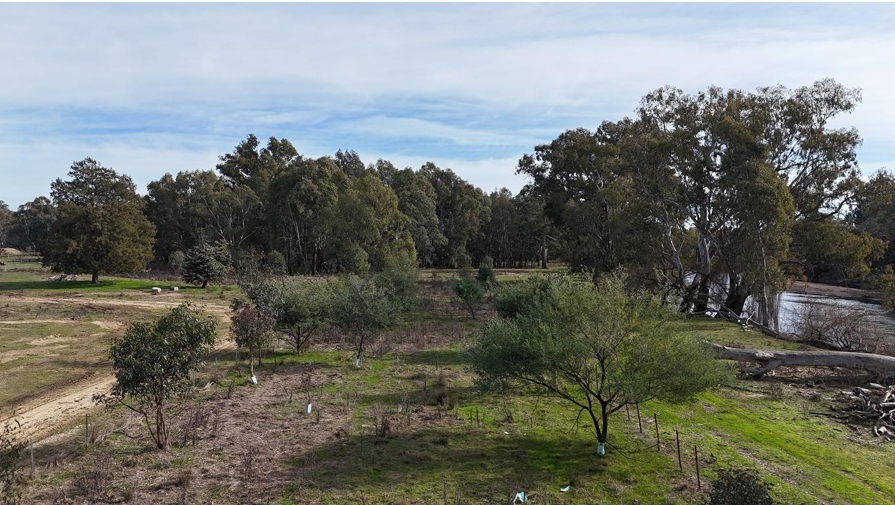
Their legacy pit, rehabilitated from 1996-2000, continues to perform despite multiple flood events with its batters remaining intact and vegetated.
Current Rehabilitation
Staged progressive rehabilitation integrates engineering foresight together with ecological sensitivity.
Stages 2, 3 & 4
Near completion with final planting and fencing.
Stages 5 & 6
Active extraction recently commenced.
Flood Conveyance Features
Vegetated rock chutes to direct overland flow into pit lakes.
Overburden Use
Reused to shape landforms, flatten batters and stormwater control.
Outcomes
Successful outcomes included the following:
- Century-Scale Stability: The site has been designed to manage and withstand regional flood behaviour and localised storm events over the next 100 years and beyond.
- Vegetation Success: Indigenous species suited to local soil and water conditions.
- Post-Mining Use: With no ongoing contamination risk, retained infrastructure will support farming.
- Rock-lined drains and pit lakes are integrated into post-closure landform.
- Simes Isolation: Slimes were sequestered under 10m (Stage 2/3) or 3m (Stage 1) of clean water, avoiding turbidity and ensuring no risk of mobilisation.
“We have implemented a self-sustaining rehabilitation strategy that combines flood-adaptive design, onsite material reuse, and revegetation with local indigenous species to deliver an ecologically sound and operationally robust outcome,” said Brendan.
Innovation
Baxter’s approach was not only compliant, but forward thinking and innovative. As quarry operators and landholders, they see themselves as custodians of the land.
Their reputation and productivity rest on the success of this rehabilitation which included the following principles:
- Flood-Modelling Led Design
- Self-Sufficiency
- Native Ecology Rebuild
Baxters Quarries has been a member of CMPA for more than 15 years.
Related Posts




You must be logged in to post a comment Login