
Workplace Exposure Limits
Dr Elizabeth Gibson General Manager CMPA provides the CMPA submission to WorkSafe Victoria’s Occupational Health and Safety Amendment Workplace Exposure Limits) Regulations.
WorkSafe Victoria provided the opportunity to comment on the Occupational Health and Safety Amendment (Workplace exposure limits) Regulations (Amendment Regulations) and accompanying Adoption of Safe Work Australia’s Workplace Exposure Limits for airborne contaminants Regulatory Impact Statement (RIS). The Workplace Exposure Standards will now be known as Workplace Exposure Limits.
Purpose
Australian Work Health and Safety ministers agreed to rename the WES list as the WEL list to make it clear that limits must not be exceeded and to align Australia with language used internationally. Additional airborne contaminants were included, some WELs were lowered (more stringent) and some were raised (less stringent).
Definition
The definition of Workplace Exposure Standard (WES) or Workplace Exposure Limit (WEL) is:
The airborne concentration of a particular substance or mixture which must not be exceeded. The exposure standard can be of three forms:
- Eight-hour time weighted average;
- Peak limitation; and
- Short term exposure limit.
Impact on the quarry industry
- The purpose of the new standard is the result of a review of the current Safe Work Australia (SWA) WES.
- From 1 December 2026, SWA will replace the WES list with the WEL for airborne contaminants list.
- The new standard incorporates additional airborne chemicals and stricter standards for some.
- The three major airborne contaminants for quarries (note others may apply) listed are:
- Welding Fumes – no change from WorkSafe Victoria (2024), New standard for welding fume safety.
- Diesel Particulate Matter – new WEL 0.01mg/m3 and
- Respirable Crystaline Silica (RCS)The current RCS exposure limit (TWA 0.05 mg/m3) has not changed to date. The Safe Work Australia (2024), Consultation paper impact analysis on the workplace exposure limits for 9 chemicals. This impact analysis (see CMPA submission https://sandandstone.cmpavic.asn.au/category/issue-138-dec-2024-jan-2025/) estimated the costs and benefits of the agreed WEL, relative to the current WES for 9 chemicals including, RCS. SWA members (WorkSafe) have received the results of this impact analysis, but these results have not yet been made publicly available as at October 2025.
- PCBUs (Person Conducting a Business or Undertaking) must ensure employees are not exposed to these hazardous substances at levels above the WEL, if any.
- PCBUs must eliminate health and safety risks so far as is reasonably practicable, and if this is not reasonably practicable, minimise those risks so far as is reasonably practicable.
The CMPA supports the principle of responsible, balanced legislation that is in the best interests of the State of Victoria and Australia.
Submission
The CMPA submits that:
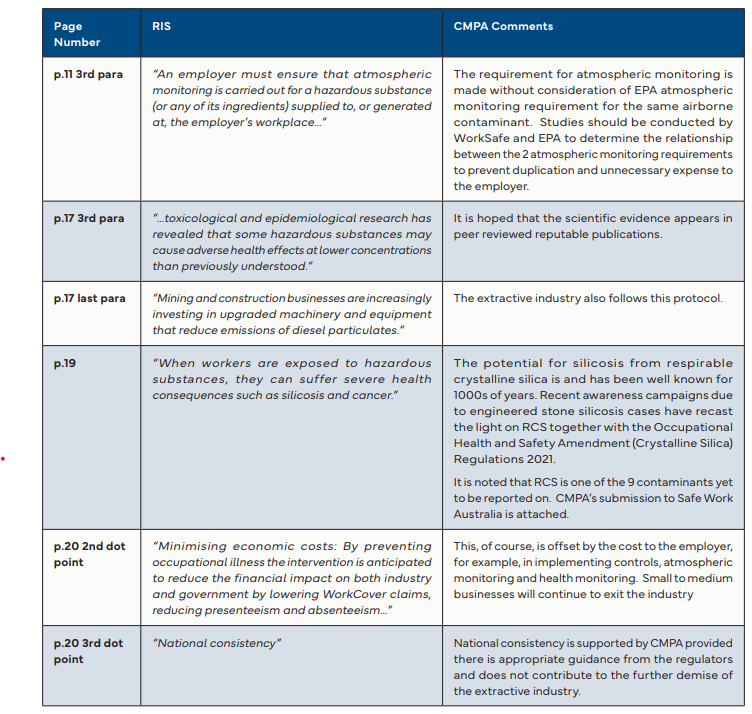
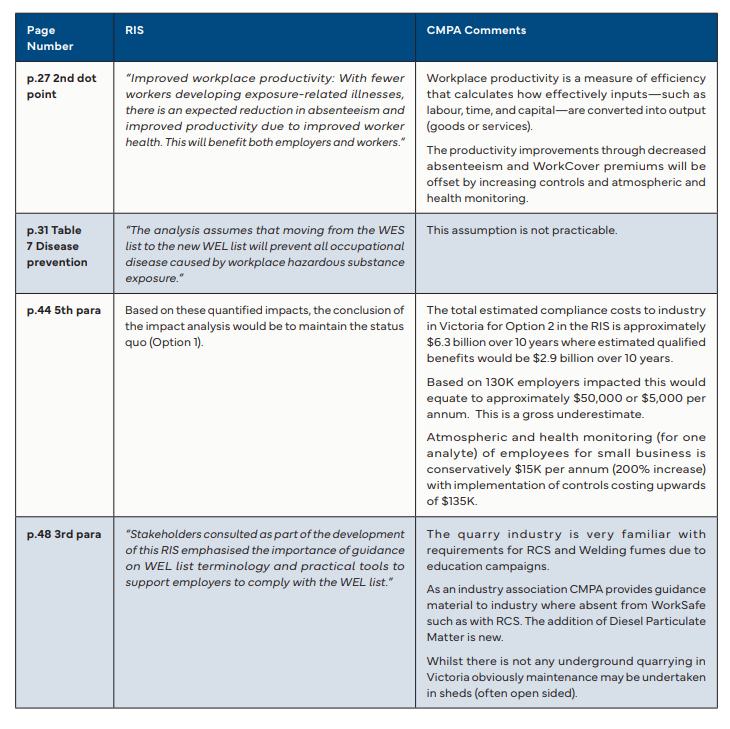
- The RIS underestimates the costs to the extractive industry by approximately 200% for atmospheric and health monitoring (of 1 analyte) even before inclusion of costs for implementation of controls.
- The new listing of Diesel Particulate Matter (0.01 mg/m3) will be challenging for the industry without simple, practicable and timely guidance being provided by WorkSafe with industry consultation.
Conclusion
The RIS is fundamentally flawed due to grossly underestimating costs to the extractive industry. Additionally, RISs in general fail to take into account the cumulative impact of ever-increasing regulation on the extractive industry.
This will result in more small to medium operators departing the market and/or increases in construction material prices thereby contributing to inflation and further increases in costs to the Victorian Governments Big Build.
Discussion
Many of CMPA Members are small to medium sized enterprises and are active in airborne contaminants management with assistance from the comprehensive CMPA guidance material such as for Respirable Crystalline Silica (RCS) dust and Welding fumes. The addition of Diesel Particulate Matter is new and so WorkSafe must provide simple, practicable and timely guidance in consultation with industry well before the implementation date,1 December 2026.
The flaw with the RIS and RISs in general is the cumulative impact of changing legislation and regulations in Victoria increasing costs for the quarry industry, for example, the Mineral Resources (Sustainable Development) (Extractive Industry) Regulations 2027 and the Occupational, Health and Safety Regulations 2027 due out for consultation soon.
The increase in red tape is in part seen through the decreasing number of Work Authorities (quarry licence) and operating quarries (mostly small to medium).
Specific Comments on the RIS



You must be logged in to post a comment Login