
Manage your Geotechnical Risk
We recently updated the CMPA ‘Working Safely with Geotechnical Risk in Quarries’ Guideline. While we featured new content relating to Section 8 of the guideline in the last Sand & Stone, the following new content relates to Section 9.
9.1 Edge Protection Berms – Mobile Equipment, Road Trucks, or Light Vehicles
The aim of the edge protection is to stop the largest, fully-loaded vehicle crossing it when travelling at the maximum foreseeable speed and it should be constructed with this in mind.
All benches, ramps and roads should have an edge protection berm to prevent fall from height to another level:
- No work should be conducted on the face side of the edge protection berm
- The outer face of the edge protection berm should be at least 2 metres or as far as is practicable back from the crest, or in the case of an unstable crest, e.g., back breaks, loose of dislodged rock or overhanging rock, at least 2 metres back from the hazard
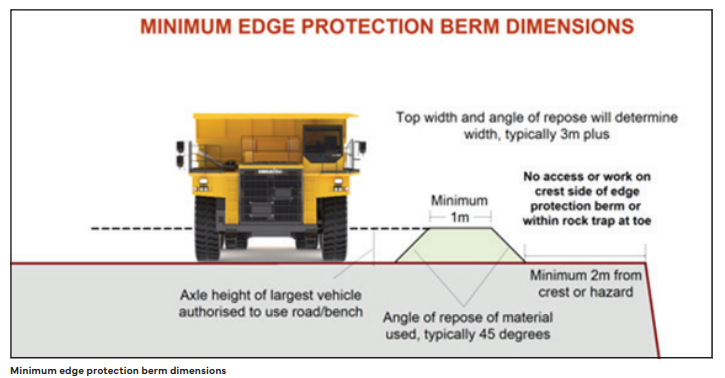
Many industry guidelines specify that edge protection berms must be at least as high as the mid-axle height of the largest piece of equipment travelling on the road.
Some guidelines also acknowledge that typical axle-height edge protection berms cannot be relied on to completely stop an errant vehicle from crossing over the berm, except at low speeds.
The CMPA recommends that where practicable, the minimum height of the edge protection berm is as high as the mid-axle height of the largest piece of equipment or heavy vehicles authorised to use the bench or road and that larger edge protection berms (i.e. height and width) are necessary for heavier vehicles and in areas where vehicles have more speed, are travelling around curves or are negotiating steep gradients.
Key points in regards to edge protection include:
- The dump truck size and the speed at which it travels are directly related to the size of the berm required
- For any given dump truck weight, the higher the speed the truck is travelling at, then the higher the risk of the truck mounting a berm and so the larger the berm height and width needs to be
- Critical velocity is defined as the velocity/speed where the edge protection berm would still be effective but any velocity exceeding that critical velocity could result in the edge protection berm being ineffective
- The critical velocities for loaded trucks are in general 5–10 km/h lower compared to unloaded trucks
- Rigid Dump Trucks (RDTs) generally have a slightly higher (5–10 km/h) critical velocity than Articulated Dump Trucks (ADTs)
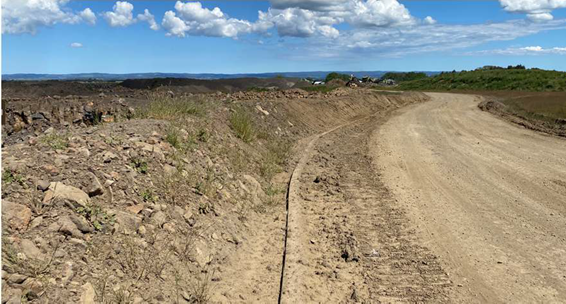
- The higher the approach angle, the smaller the critical velocity, i.e. a head-on collision is the worst-case scenario. The effectiveness of the edge protection berms drops considerably in these scenarios (75° to 90° approach). These scenarios are most likely around high risk areas, for example a steep incline heading towards a corner, sharp bend or T intersection
- Both edge protection berm height and width should be increased in such areas and additional measures like runaway provisions or double berms should be used
- A lower approach angle 15° to 30° allows a higher critical velocity
- Edge protection berms on working haul roads should be constructed out of unweathered, well graded, freely draining, materials which can be easily maintained and act as a suitable vehicle barrier and constraint
- The material should also be compacted to a certain degree, especially the first layer to assure good integration with the ground surface
- The amount of material (i.e. mass and volume) used for the edge protection berm construction is crucial as it provides the main resistance to the impact, particularly at velocities above 20 km/h. The width of the edge protection berm (top and base) and its roadside-facing batter are as important as the height
- The width of the edge protection berm must take into account the width of the bench or haul road allowing for the designated one or two-way traffic direction and rock traps where required, the potential angle of repose of the construction material and the maximum
- distance achievable from the crest. Where these factors cause a reduction in the width, therefore the height, the maximum speed limit (critical velocity) must be reduced to accommodate these factors
- Edge protection berms can deteriorate over time due to wet weather and erosion therefore it is important to maintain the top width of the berm, allowing the inner and outer walls to sustain their angle of repose
- Where necessary to ensure the drainage of surface water, gaps may be left in the edge protection berm, or other drainage systems provided such as rip rap material. Any gaps must not be wide enough for a vehicle to pass through
- Both the edge protection berm and the drainage points must be routinely inspected to monitor deterioration, and suitable remedial measures implemented. Uncontrolled drainage or water build up could penetrate into the face and cause instability
- The edge protection berm should be inspected after each blast in its proximity and significant rain events to ensure its structural integrity
- Where practical, two-way reflector posts should be installed on top of edge protection berms (narrower roads) or off-side from the edge protection berms (wider roads) to alert the dump truck driver to its
- location.in dark or foggy conditions. Reflector posts should be inspected, maintained and cleaned after road watering or heavy rain where truck tyres splash mud onto the posts.
9.2 Edge Protection Berms – Workers
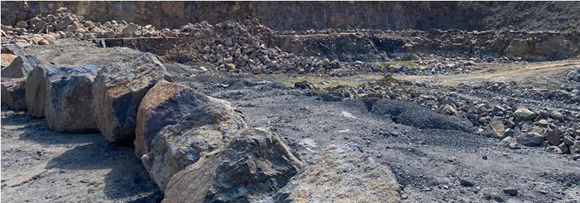
For pedestrians/workers and shot-firing activities only, berms should be a minimum height of one metre where practicable and constructed from a suitable material to avoid trip hazards. Light vehicle and mobile equipment access to areas where edge protection berms for workers are installed should be physically restricted by fence, dump of materials, or other suitable barriers to ensure the light vehicle or mobile equipment cannot access the area.
Note: WorkSafe Victoria advise in their Guidance “Preventing falls from Quarry Faces” published on their website, that if it is not reasonably practicable to install bunds/ berms, other physical fall prevention barriers such as guard railing should be used. If the guard railing is installed close to a quarry face, the risk of falls during the erection and dismantling of the guard railing must be identified and controlled.
If it is not reasonably practicable to install a physical fall prevention device (e.g. before blasting or due to the set-up of a drill), limit working positions. This can include using a travel restraint such as a harness connected at a fixed point (e.g. fixed equipment) to prevent workers approaching the edge.
Workers must be trained in the appropriate selection and use of harnesses before starting work. Ensure workers are closely supervised until assessed as competent.
The following are not endorsed/supported:
- The use of physical fall prevention barriers such as guard railing due to the risk associated with their installation and removal;
- The use of a spray-painted line inset at a safe distance from the face i.e., body length, as it is a low order administrative control, less effective in preventing falls and it would be difficult for members to prove that a higher order of control as per the Hierarchy of Controls would not be reasonably practicable.
For copies of the updated Guideline visit the CMPA website




You must be logged in to post a comment Login